P1 Registration 2027: Phases, 2C Balloting and Tips
13 October 2026 · Tutor Circle
The 2027 Primary 1 registration exercise is for children starting Primary 1 in 2028. The phase rules change in one place that matters to most families: Phase 2C. MOE will reserve 60 places there at most schools, up from 40, and 12 schools will ballot on two tracks, within 2 km and beyond 2 km. The 2027 dates are not published yet. The 2026 exercise ran from June to August.
- Who it is for
- Children starting P1 in 2028. The 2026 exercise was for the 2027 P1 cohort
- When
- Dates not out. The 2026 exercise ran June–August, results through 27 August
- Phase 2C places
- 60 reserved at most schools, up from 40. Smaller-intake schools stay at 40
- Two-track schools
- 12 schools. Places split equally between ≤2 km and >2 km
- One school
- One school per phase. The latest submission in that phase is the one MOE uses
- If 2C fails
- Phase 2C Supplementary, then a posting to a school with a vacancy
Who each phase is for

Phases 1 to 2C Supplementary are for Singapore Citizens and Permanent Residents. International students are considered in Phase 3, after citizens and PRs. Eligibility for Phases 1, 2A and 2B does not change in 2027. The change is the number of Phase 2C places, and the two-track rule at 12 schools. [1] [4]
| Phase | Who may register | Places held back |
|---|---|---|
| 1 | A sibling is currently a pupil of that school | No reserved pool. This phase runs first |
| 2A | A parent or sibling is a former student, a parent sits on the school advisory or management committee, a parent is staff, or the child is in the on-site MOE Kindergarten | Places left over flow to 2B and 2C in a 1:2 ratio |
| 2B | A qualifying parent volunteer, a parent endorsed by a connected church or clan, or a parent endorsed as an active community leader | 20 reserved places |
| 2C | Any Singapore Citizen or PR child, with or without a tie to the school | 60 reserved at most schools. Smaller-intake schools keep 40 |
| 2C Supplementary | A child who still has no place after Phase 2C | Vacancies that remain |
| 3 | International students | After citizens and PRs |
A qualifying parent volunteer has to have joined by 1 July the year before registration and completed at least 40 hours of service by 30 June of the registration year. That rule is unchanged. If you are counting on Phase 2B, check the hours now, not in June.
The 2026 exercise, which placed children into Primary 1 in 2027, announced results on 8 July, 17 July, 27 July, 11 August and 27 August. Those dates are a picture of the shape, not the 2027 calendar. MOE publishes each year’s dates on its registration page. [3]
How balloting works
Balloting happens when applicants outnumber places. MOE runs it centrally by computer. In Phases 2A, 2B and, at ordinary schools, 2C, Singapore Citizens are placed before Permanent Residents, and distance breaks the citizen queue into three groups: within 1 km, between 1 km and 2 km, and beyond 2 km. Home-school distance uses the address you register with.
You may register for only one school in a phase. A second submission in the same phase replaces the first. If Phase 2A or 2B is unsuccessful, you move to the next phase you are eligible for. Phase 2C is open to everyone, which is why it is the phase that ballots.
The 12 two-track schools
At these schools, Phase 2C places, including the reserved places, are split equally. One track is for children living within 2 km. The other is for children living further away. There is no 1 km priority inside a track. If every Singapore Citizen in one track is admitted and places remain, those places move to Singapore Citizen applicants in the other track. Permanent Residents are considered after citizens in both tracks. [1]
| School | Address in the annex |
|---|---|
| Anglo-Chinese School (Junior) | 16 Winstedt Road |
| Anglo-Chinese School (Primary) | 50 Barker Road |
| CHIJ (Katong) Primary | 17 Martia Road |
| Methodist Girls’ School (Primary) | 11 Blackmore Drive |
| Nanyang Primary School | 52 King’s Road |
| Ngee Ann Primary School | 344 Marine Terrace |
| Pei Hwa Presbyterian Primary School | 7 Pei Wah Avenue |
| Raffles Girls’ Primary School | 21 Hillcrest Road |
| Singapore Chinese Girls’ Primary School | 190 Dunearn Road |
| St Margaret’s School (Primary) | 136 Sophia Road |
| Tanjong Katong Primary School | 10 Seraya Road |
| Tao Nan School | 49 Marine Crescent |
MOE selected these schools because public housing is less than 40% of dwelling units within 2 km. The list will be reviewed. It is not expected to change often, because housing around a school changes slowly. [2] Past vacancy and balloting figures for other schools are on the primary school registration page.
Before you submit
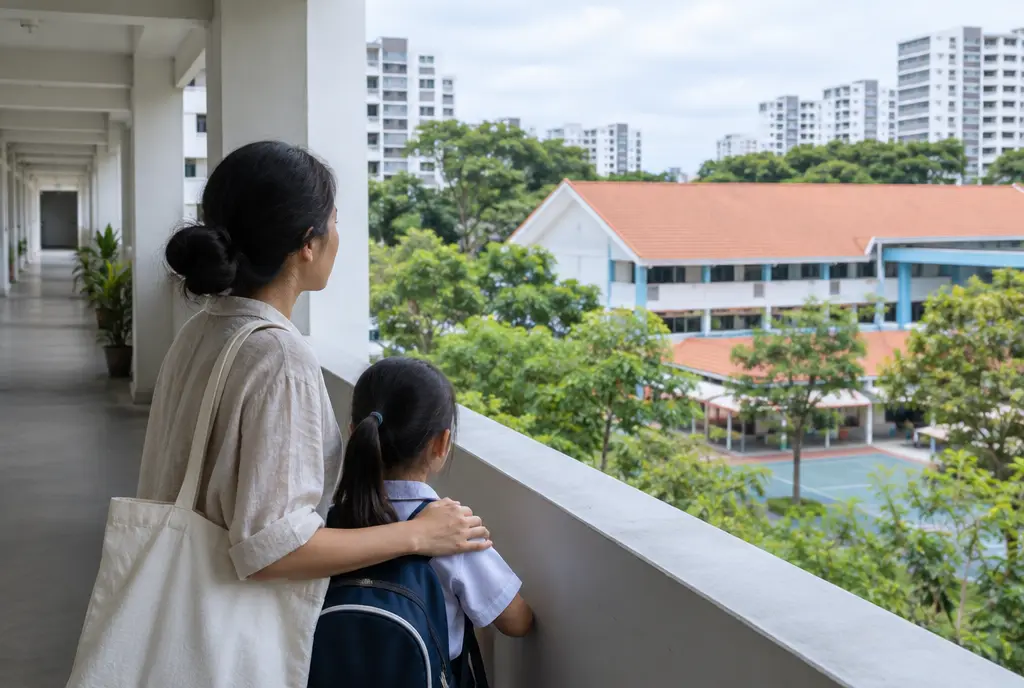
Decide the school before the phase opens
- Use MOE’s distance checker on the address you will actually register. A 1.9 km home and a 2.1 km home are different queues, and at a two-track school they are different tracks.
- Look at last year’s Phase 2C outcome for that school. A school that admitted every applicant is a different bet from a school that balloted citizens within 1 km.
- Have a second school in mind for 2C Supplementary before you submit 2C. Deciding during the result SMS is how families pick a school they have never visited.
- Submit once, for one school. If you must amend, do it early in the phase. The latest submission replaces the earlier one.
- Phase 2B volunteers: the July and June deadlines fall the year before, and during, the exercise. Missing them by a week drops you into Phase 2C.
Registration is several years before PSLE. The academic path after that, including what an AL score means, can wait. The calendar those children will eventually meet is on the 2027 school calendar, which is the year before this cohort even starts Primary 1.
Questions parents ask
When is P1 registration 2027?
The 2027 P1 Registration Exercise is for children starting Primary 1 in 2028. MOE has not published the 2027 phase dates. The 2026 exercise, for children starting Primary 1 in 2027, ran from June to August, with results on 8 July (Phase 1), 17 July (2A), 27 July (2B), 11 August (2C) and 27 August (2C Supplementary). Expect a similar June-to-August window and confirm the dates on moe.gov.sg when they are released.
What changes in Phase 2C from 2027?
From the 2027 exercise, MOE reserves 60 Phase 2C places at most schools, up from 40. Schools with a smaller intake keep 40 reserved places. At 12 named schools, Phase 2C places are split equally between children living within 2 km and children living beyond 2 km. Inside each of those tracks there is no further distance priority. Singapore Citizens are still admitted before Permanent Residents.
How does P1 balloting work?
If a phase has more applicants than places, MOE runs a computerised ballot. In a normal school, Singapore Citizens within 1 km are taken first, then Singapore Citizens between 1 km and 2 km, then Singapore Citizens beyond 2 km, and only then Permanent Residents in the same distance order. At the 12 two-track schools, Phase 2C ignores the 1 km line and ballots inside the ≤2 km track and the >2 km track separately. You register for one school in a phase.
Which schools use the two-track Phase 2C scheme?
Anglo-Chinese School (Junior), Anglo-Chinese School (Primary), CHIJ (Katong) Primary, Methodist Girls’ School (Primary), Nanyang Primary, Ngee Ann Primary, Pei Hwa Presbyterian Primary, Raffles Girls’ Primary, Singapore Chinese Girls’ Primary, St Margaret’s School (Primary), Tanjong Katong Primary and Tao Nan School. MOE chose them because public housing is under 40% of homes within 2 km. The list can be reviewed. Use MOE’s annex for the exercise you are in.
What if my child is unsuccessful in Phase 2C?
You register again in Phase 2C Supplementary, for a school that still has vacancies. If that is also unsuccessful, MOE posts the child to a school with a place. Registering for several schools in one phase is not allowed. MOE takes the latest submission made during the phase, so a last-minute change can overwrite the school you meant to keep.
Sources
- Ministry of Education, “Enhancing the Primary One Registration Framework for Greater Access and Inclusivity,” 10 September 2026. From the 2027 P1 Registration Exercise, Phase 2C reserved places rise from 40 to 60 except at smaller-intake schools, and a Two-Track Scheme applies at 12 schools. Phases 1, 2A, 2B, 2C Supplementary and 3 are otherwise unchanged. Accessed 13 October 2026. https://www.moe.gov.sg/news/press-releases/20260910-enhancing-the-primary-one-registration-framework-for-greater-access-and-inclusivity
- Ministry of Education, Annex A, list of primary schools implementing the Two-Track Scheme in Phase 2C from the 2027 P1 Registration Exercise. Twelve schools, where public housing accounts for less than 40% of dwelling units within 2 km. Accessed 13 October 2026. https://www.moe.gov.sg/media/newsroom/news/press/2026/b0d58e7a-5220-49b9-bc9c-a7f783a4f510.pdf
- Ministry of Education, P1 registration results page, updated 31 August 2026. Result dates for the 2026 exercise: Phase 1 on 8 July, Phase 2A on 17 July, Phase 2B on 27 July, Phase 2C on 11 August, Phase 2C Supplementary on 27 August. Computerised balloting is conducted centrally by MOE. Accessed 13 October 2026. https://www.moe.gov.sg/primary/p1-registration/results
- Ministry of Education, overview of the revised framework. Phase 1 is a sibling currently in the school. Phase 2A is a former-student parent or sibling, a school advisory or management committee parent, a staff parent, or a child in the on-site MOE Kindergarten. Phase 2B is a qualifying parent volunteer, a church or clan endorsement, or an active community leader, with 20 reserved places. Accessed 13 October 2026. https://www.moe.gov.sg/media/newsroom/news/press/2026/b1583b80-bad7-4cbe-8818-f096554fa661.pdf