PSLE Maths Fractions and Percentages: Common Mistakes and Worked Examples
9 November 2026 · Tutor Circle
Primary 5 standard mathematics multiplies fractions and takes a percentage of an amount. [1] The P4 to P5 page stops before that. It checks whether “of” means a share of a set. Stay on that page if your child still subtracts the denominators. The examples below were written for this page. They are not from a school paper.
- Start here only if
- A fraction of a set is already secure
- A fraction of a fraction
- Two thirds of the water in a three-quarter bottle is half the bottle
- A remainder
- The second fraction uses what is left, not the original amount
- Percent
- The share and the base are different numbers
- A discount, backwards
- $40 after 20% off was $50, not $48
The share is not the amount
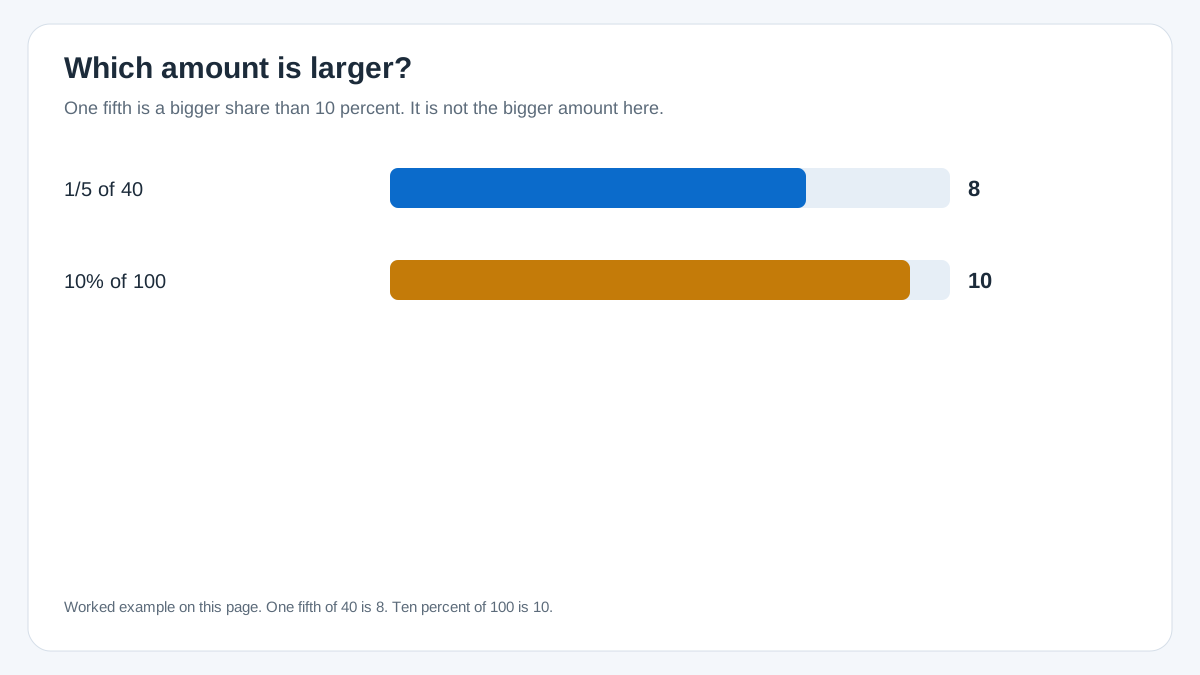
One fifth of 40 is 8. Ten percent of 100 is 10. A child who says “one fifth is bigger than 10 percent, so 8 is bigger” has compared the labels and skipped the bases. The fix is to write the amount under each share before any sentence about which is greater. If this comparison fails because the child cannot yet find one fifth of 40, go back to the P4 to P5 checks. [2]
A fraction of the water in the bottle
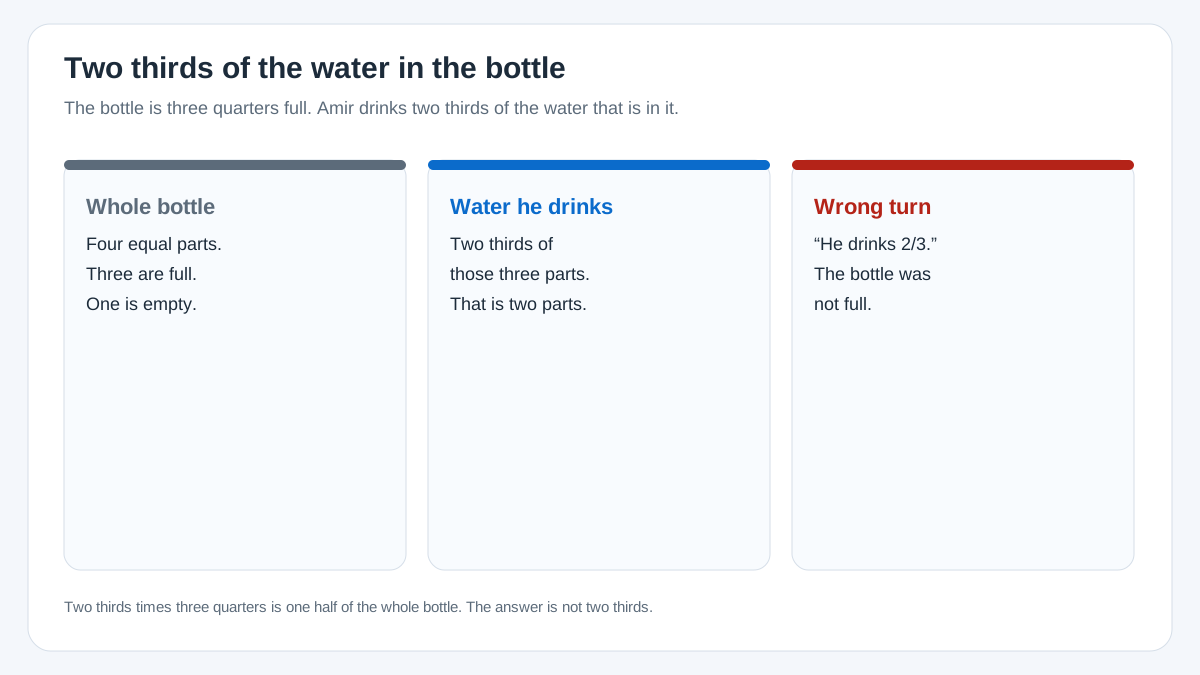
A bottle is 3/4 full. Amir drinks 2/3 of the water that is in the bottle. What fraction of the whole bottle does he drink?
The water in the bottle is 3/4 of the bottle. He drinks 2/3 of that water. 2/3 × 3/4 = 1/2. He drinks half of the whole bottle.
- Answering 2/3 uses the fraction in the sentence and ignores that the bottle was not full.
- Adding 2/3 and 3/4 makes a fraction bigger than one bottle. Nothing in the story was added.
- Subtracting 2/3 from 3/4 answers a different question: how much of the bottle would be left if those fractions were of the same whole, which they are not.
A fraction of the remainder
Priya has $48. She spends 1/3 of the money on a book. She spends 1/4 of the remainder on a pen. How much is left?
The book is 1/3 of $48, which is $16. The remainder is $32. The pen is 1/4 of $32, which is $8. She has $24 left.
“Of the remainder” changes the base. One quarter of the original $48 is $12, and that is the usual wrong pen. Adding the fractions first, 1/3 + 1/4 = 7/12 of $48, spends $28 and also leaves $20. Two wrong methods, one wrong total.
Percent off, and percent backwards
A bag costs $80. A sale takes 25 percent off. Twenty-five percent of $80 is $20, so the sale price is $60. Subtracting 25 from 80 treats the percent sign as dollars. The sale price is not $55.
A choir of 20 children increases by 10 percent. Ten percent of 20 is 2, so there are 22 children. Adding 10 to 20 answers “increased by 10 children”. “Increased to 10 percent” would be a different sentence again. Read the word after increased before you touch the calculator.
The price after the discount is not the base
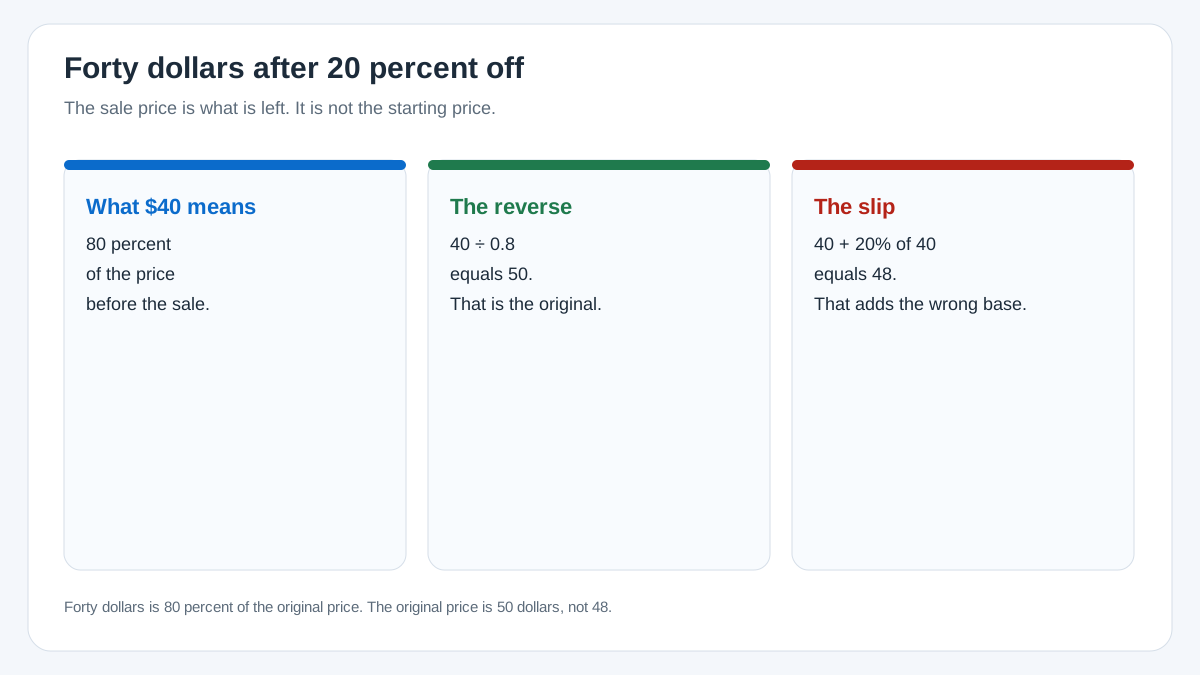
A shirt costs $40 after a 20 percent discount. The $40 is the part that is left, so it is 80 percent of the price before the sale. 40 ÷ 0.8 = 50. The original price is $50. Check: 20 percent of $50 is $10, and $50 − $10 = $40.
Adding 20 percent of $40 gives $48. That is the price you would get by putting 20 percent on top of the sale price. It does not undo the discount. Twenty percent of $48 is $9.60, and $48 − $9.60 is $38.40, not $40.
The error, in one line
| Example | A result that looks finished | The step that was skipped |
|---|---|---|
| 1/5 of 40 against 10% of 100 | “1/5 is bigger, so 8 is bigger” | Write both amounts before comparing |
| 2/3 of the water in a 3/4 bottle | 2/3 | The bottle was not the whole |
| 1/4 of the remainder of $48 | $20 left | The pen used $48, not $32 |
| 25% off $80 | $55 | 25 was treated as dollars |
| 20 children, up by 10% | 30 children | 10 was treated as children |
| $40 after 20% off | $48 | 20% was added to the sale price |
Worked questions in the same style sit on the Primary 6 maths diagnostic and the Primary 5 maths page. Model drawing, which is a picture for a different family of questions, is on the model drawing page.
Questions parents ask
Is this the same as the P4 to P5 maths page?
No. That page checks three earlier skills: a fraction of a set, tenths against hundredths, and area against perimeter. This page starts after those. The examples here are a fraction of a fraction, a fraction of a remainder, and percent, including a discount worked backwards.
Why is “one fifth” not always bigger than “10 percent”?
One fifth is a larger share than 10 percent. The amount depends on the number being shared. On this page, one fifth of 40 is 8 and 10 percent of 100 is 10. Comparing the shares and ignoring the bases gives the wrong amount.
How do I undo a 20 percent discount?
If $40 is the price after 20 percent off, $40 is 80 percent of the original price. Divide 40 by 0.8. The original price is $50. Adding 20 percent of $40 gives $48, which is a different question.
What should I tell a tutor?
Name the step, not the topic label. “Primary 6, takes the fraction of the original amount when the question says remainder” is a brief. “Weak at fractions” will often restart the chapter.
Sources
- Ministry of Education, 2021 Primary Mathematics Syllabus, Primary 1 to Primary 6, updated October 2025. Primary 5 standard number topics include multiplication of fractions and percentage. Accessed 9 November 2026. https://www.moe.gov.sg/primary/curriculum/syllabus
- Tutor Circle, P4 to P5 maths. The earlier checks this page does not repeat: a fraction of a set, tenths and hundredths, and area. Accessed 9 November 2026. https://tutorcircle.sg/p4-to-p5-maths