PSLE Maths Model Drawing: Before-and-After Questions Explained
27 October 2026 · Tutor Circle
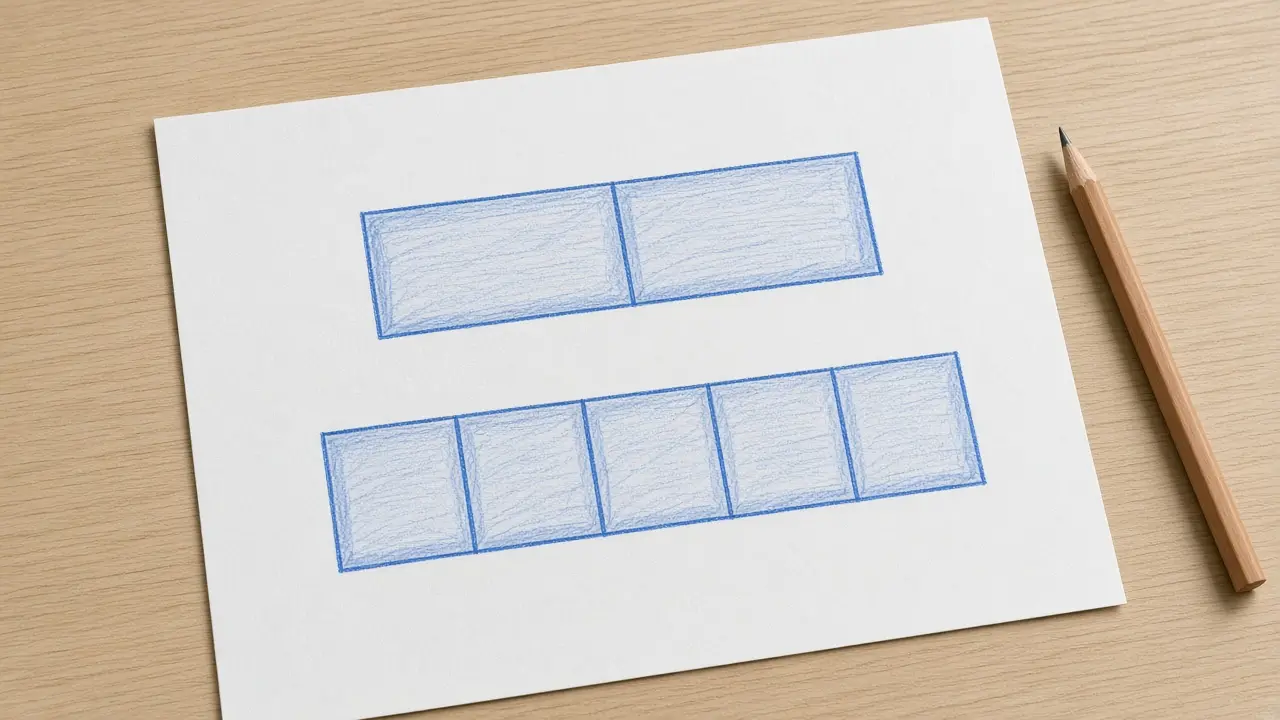
The heuristics list gives before-and-after one worked line. This page is the drawing. You draw the start, you draw the later moment, and you mark the part that did not change. The units that differ are the amount that was added or given away.
- Draw
- A before bar and an after bar, in the same units
- Find
- The part that stayed the same, so the change has a size
- The change
- Equals the amount added, removed, or handed over
- A trap
- A story that only tells you the change, and not a starting amount
- Not a PSLE format
- Schools teach the drawing. SEAB does not publish it as a paper style
Five steps
MOE’s primary syllabus asks pupils to use heuristics. It does not prescribe this diagram. [1] SEAB examines mathematics. It does not publish “before-and-after” as a paper type. [2] Schools still teach the drawing because the stories keep using two moments. The twelve-method overview, with one line on this method, is on the heuristics page.
- Read for two moments. Circle the words that mean before, and the words that mean after.
- Draw the before bar. If there are two people, draw both, in the ratio or the “times as many” the question gives.
- Draw the after bar with the same unit size. Do not start a fresh unit just because the story moved on.
- Shade, or bracket, the part that is different. That difference is the amount the question named: the water poured in, the stamps given, the marbles handed over.
- Find one unit. Then answer the question that was asked, which may be the start, the end, or one person. Stop when that number is labelled.
A bottle, filled twice
A bottle was 1/3 full. After 400 ml was poured in, it was 5/6 full. How much does the bottle hold?
One-third is two-sixths, so the bottle is easier to see in six equal parts. Before uses 2 of them. After uses 5. The pour added 3 parts, and those 3 parts are 400 ml. One part is 400 ÷ 3 ml, which is awkward, so stay in parts: 3 parts = 400 ml, and the full bottle is 6 parts. Half of the bottle was added, because 3 parts out of 6 is a half. The bottle holds 800 ml.
The mistake is to treat 400 ml as one unit, or as the whole bottle. The 400 ml is only the part that changed. A child who writes 400 ml as the answer has found the change and labelled it as the question. Ask: “Is 400 the water we poured, or the bottle?”
Two people, one transfer

Wei had 3 times as many marbles as Nora. After Wei gave Nora 8 marbles, they had the same number. How many marbles did Wei have at first?
Before: Wei 3 units, Nora 1 unit. After they are equal, each has 2 units. One of Wei’s units moved to Nora. The story says that unit is 8 marbles. Wei started with 3 × 8 = 24. Check the ending, because a before-and-after answer that fails the ending was the wrong unit: Wei has 24 − 8 = 16, Nora has 8 + 8 = 16. They match.
When the same story cannot be solved
Six pupils left a room and ten pupils joined. There were then 4 more pupils than at the start. How many were there at the start? The model shows a net change of 4, which the question already told you. Nothing pins down the original bar. A child who answers “24” has invented a unit. The right response is that the question does not give a starting amount. Primary teachers use this to stop a habit of writing any number that appears.
Three questions
Written for this page. Not past-year questions. Draw both moments before you calculate.
| Question | What to draw | Answer |
|---|---|---|
| A tank was 2/5 full. After 18 litres were added, it was 4/5 full. How much can the tank hold? | Five equal parts. Two filled, then four filled. The two new parts are 18 litres. | One part is 9 litres. The tank holds 45 litres. |
| Priya and Jun had money in the ratio 5 : 3. Priya gave Jun $20, and then they had the same amount. How much did Priya have at first? | Priya 5 units, Jun 3. The gap is 2 units. Giving $20 closes that gap, so 2 units = $40. | One unit is $20. Priya had $100. Check: 80 and 80. |
| A jar of cookies had some left. Mei ate 6 and then baked 6 more. How many cookies were in the jar at the start? | The after bar is the same length as the before bar. The change is zero. | The question cannot be answered. Eating 6 and baking 6 does not reveal the start. |
If the first two drawings are messy and the arithmetic is fine, the practice is the drawing, five questions of the same shape, not a new heuristic. If the child will not start, the gap may be fractions or ratio rather than the model. Those are separated on the Primary 5 page, including the fact that ratio is a Primary 6 topic on the current syllabus. The letter version of the same bar is on the Sec 1 algebra page.
Questions parents ask
What is a before-and-after model?
Two drawings of the same story. The first bar is the amount at the start. The second is the amount after something is added, given away, or moved to another person. The part that did not change is drawn the same length, so you can see which units the change is worth.
How is this different from an ordinary bar model?
An ordinary comparison model is one moment: Mei has 4 times as many as Ravi. A before-and-after model is two moments, and the question is about the difference between them. If you draw only the “after”, you have thrown away the information that solves it.
What if the question cannot be solved?
Some stories only tell you the change. “Six pupils left and ten joined, so there were four more than at the start” tells you the net change, which you already used. It does not tell you how many there were. A child who writes a number anyway has not noticed that the model has no fixed unit. That is worth catching.
Is model drawing still useful in Secondary 1?
Yes. The unchanged bar is what Secondary 1 writes as the same letter on both sides of an equation. A child who can say “the difference is one unit, and that unit is the net change” can later write the equation without drawing it.
Where are the other heuristics?
On the heuristics page, one short example each, including a single before-and-after line. This page is the drawing in full. The questions here were written for practice. They are not past-year PSLE questions.
Sources
- Ministry of Education, primary mathematics syllabus. The syllabus develops problem-solving, including heuristics. It does not publish a numbered list of twelve methods, and it does not print a required diagram style. Accessed 27 October 2026. https://www.moe.gov.sg/primary/curriculum/syllabus
- Singapore Examinations and Assessment Board, PSLE formats examined in 2026. Mathematics is a PSLE subject. Model drawing is a method taught in school, not a format SEAB publishes as its own. Accessed 27 October 2026. https://www.seab.gov.sg/psle/psle-formats-examined-in-2026/