


PSLE English Synthesis and Transformation: Common Errors and Practice Examples
9 November 2026 · Tutor Circle
Synthesis and transformation asks the child to join two sentences, or to rewrite one, without changing the meaning. The year’s format is on SEAB’s site. [1] The six pairs below are original. A grammatical sentence can still be the wrong answer if a word has been added, a tense left behind, or the meaning turned around. More Paper 2 items, with the error tagged, are on the Primary 6 English diagnostic. [2]
- The test
- Same meaning, in the form the question asked for
- Although
- Do not add but
- Neither… nor
- Nor, and a singular verb when both subjects are singular
- Said that
- Keep the speaker’s moment: was, then
- Unless
- Do not keep the “not” from if… not
In this guide
Where these six slip
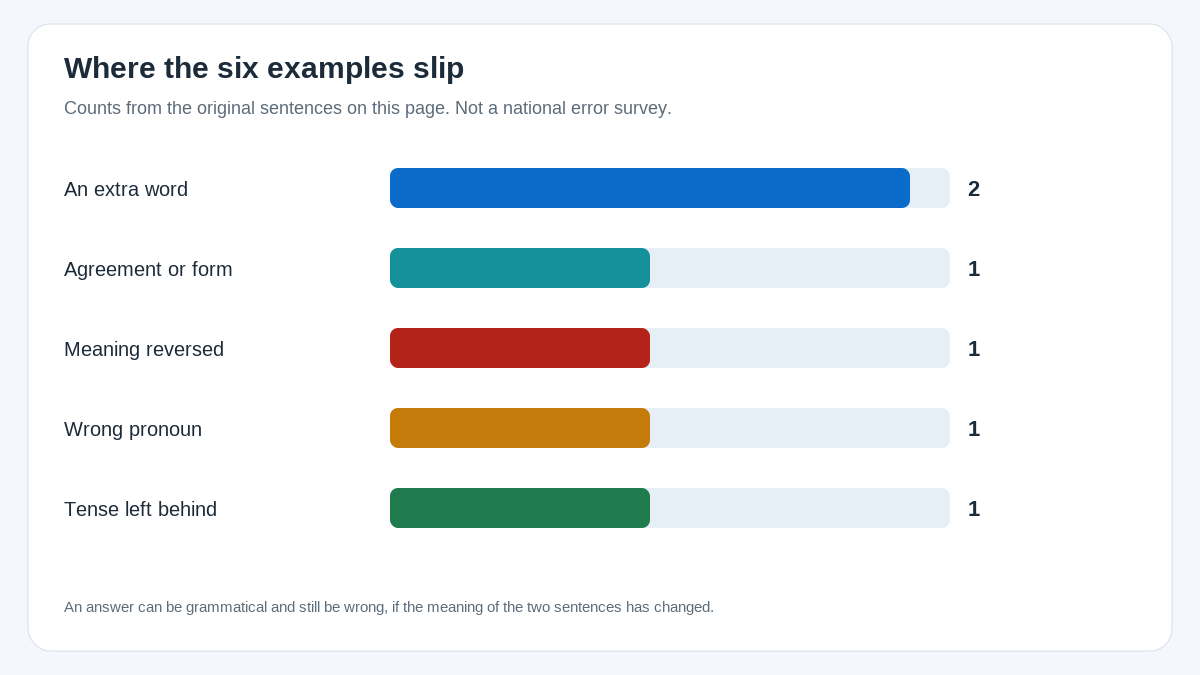
Two of the six add a word the meaning did not need. The other four fail one each: the verb or the joining word, a meaning turned around, a pronoun for the wrong kind of noun, and a tense left in the present. Read the pair aloud after the rewrite. If you can still hear both original sentences, the join has probably kept them.
Although, and prefer
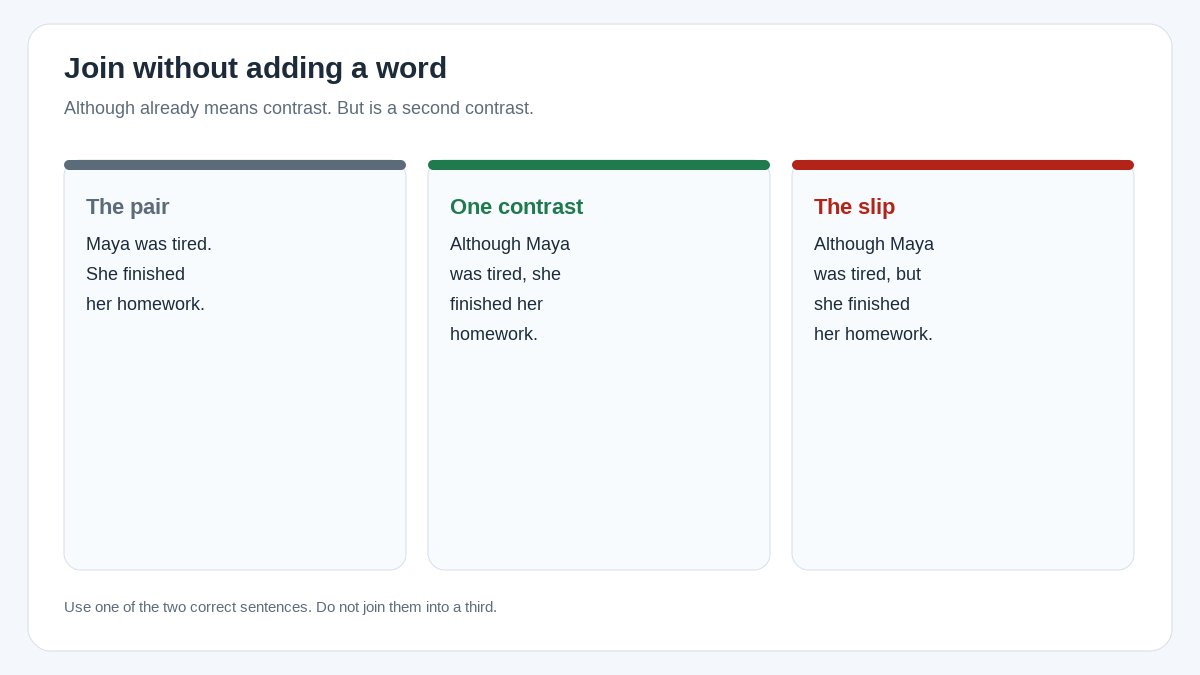
Maya was tired. She finished her homework. “Although Maya was tired, she finished her homework.” Or “Maya was tired, but she finished her homework.” “Although Maya was tired, but she finished her homework” uses both.
Tom likes swimming more than running. With prefer: “Tom prefers swimming to running.” “Tom prefers swimming more than running” keeps more, which prefer already contains, and swaps to for than.
Nor, who, and unless
Neither… nor
Ben does not like durian. His sister does not like durian. “Neither Ben nor his sister likes durian.” Or instead of nor is the wrong pair. Like instead of likes treats two singular subjects as a plural. Neither… nor, with two singular subjects, takes the singular verb.
Who, not which
The boy lives next door. He found my wallet. “The boy who lives next door found my wallet.” Which is for things. The boy is a person, so the pronoun is who.
Unless
You will miss the bus if you do not leave now. With unless: “You will miss the bus unless you leave now.” “Unless you do not leave now” keeps the not and reverses the meaning. Unless already means if not.
Say the wrong unless sentence out loud and follow it. It tells the child to stay, and still claims they will miss the bus. That is the check: act it out.
Said that
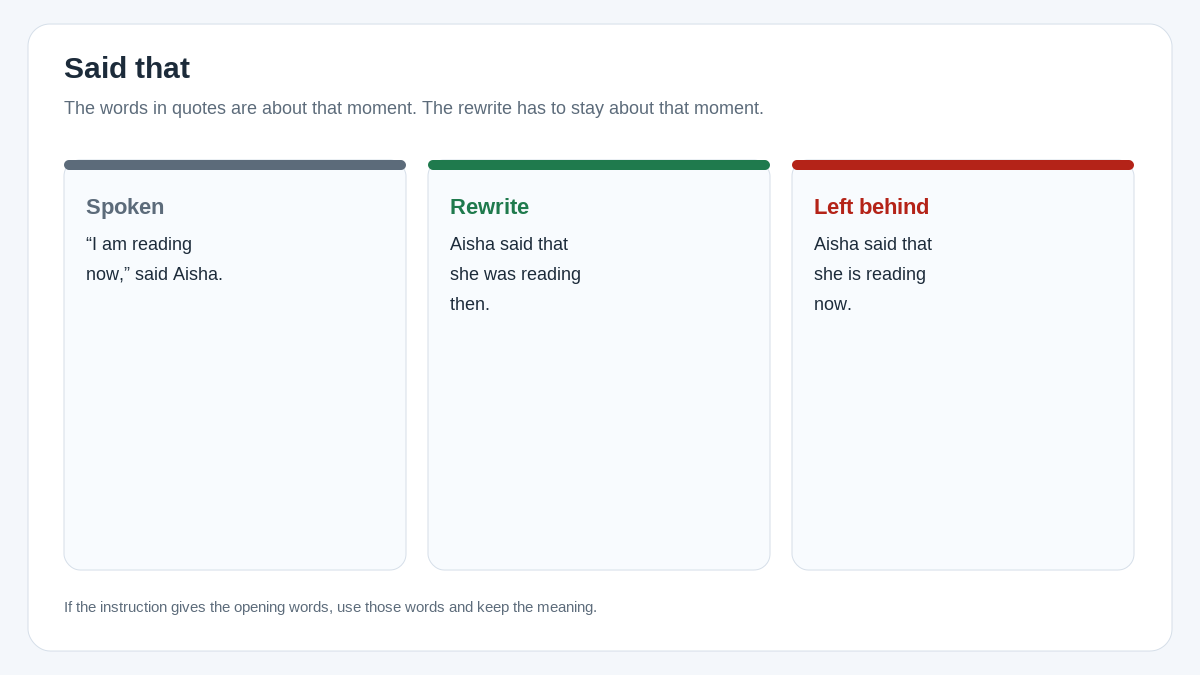
“I am reading now,” said Aisha. “Aisha said that she was reading then.” The exercise is to report that moment. Leaving is and now in the sentence can sound fine at the dinner table if Aisha is still reading. It has not done the transformation.
Comprehension, where the risk is copying a true sentence that does not answer the question, is a different paper skill. It is on the comprehension page.
The six, in one table
| Given | Keeps the meaning | The slip |
|---|---|---|
| Maya was tired. She finished her homework. | Although Maya was tired, she finished her homework. | Although… but… |
| Tom likes swimming more than running. | Tom prefers swimming to running. | prefers… more than |
| Ben does not like durian. His sister does not. | Neither Ben nor his sister likes durian. | or, and like |
| The boy lives next door. He found my wallet. | The boy who lives next door found my wallet. | which, for a person |
| You will miss the bus if you do not leave now. | You will miss the bus unless you leave now. | unless you do not |
| “I am reading now,” said Aisha. | Aisha said that she was reading then. | is reading now |
- Cover the middle column and rewrite from the left.
- Tick the meaning before you tick the grammar.
- If the same slip appears on two tries, that is the line to put on a tutor request.
An English tutor for this skill should mark the meaning, not only the spelling. Say “Primary 6, synthesis, although with but” or whichever row is the repeated one.
Questions parents ask
Are these sentences from the PSLE?
No. They were written for this page. A child who memorises them will be rewriting different sentences in the exam. Confirm the year’s paper on SEAB’s PSLE formats page. This guide does not invent a mark scheme.
Is “Although… but…” always wrong?
In this exercise, yes. Although already marks the contrast. But marks it a second time. Either “Although Maya was tired, she finished her homework” or “Maya was tired, but she finished her homework.” Not both.
Why change “now” to “then”?
The words in quotes are about the moment Aisha spoke. “Aisha said that she was reading then” keeps that moment. “She is reading now” can be true in ordinary conversation if she is still reading. It does not show the change the exercise is asking for.
Where are more questions?
The Primary 6 English diagnostic has original Paper 2 items, including a join that changes the sentence, with the error type marked. Comprehension, which is a different task, has its own page.
Sources
- Singapore Examinations and Assessment Board, PSLE formats examined in 2026. Use the year’s format page for what English Paper 2 contains. Accessed 9 November 2026. https://www.seab.gov.sg/psle/psle-formats-examined-in-2026/
- Tutor Circle, Primary 6 English diagnostic. Original questions, including synthesis, with each wrong choice tagged by error type. Accessed 9 November 2026. https://tutorcircle.sg/free-test-papers/primary-6/english