PSLE English Composition and Situational Writing
13 October 2026 · Tutor Circle
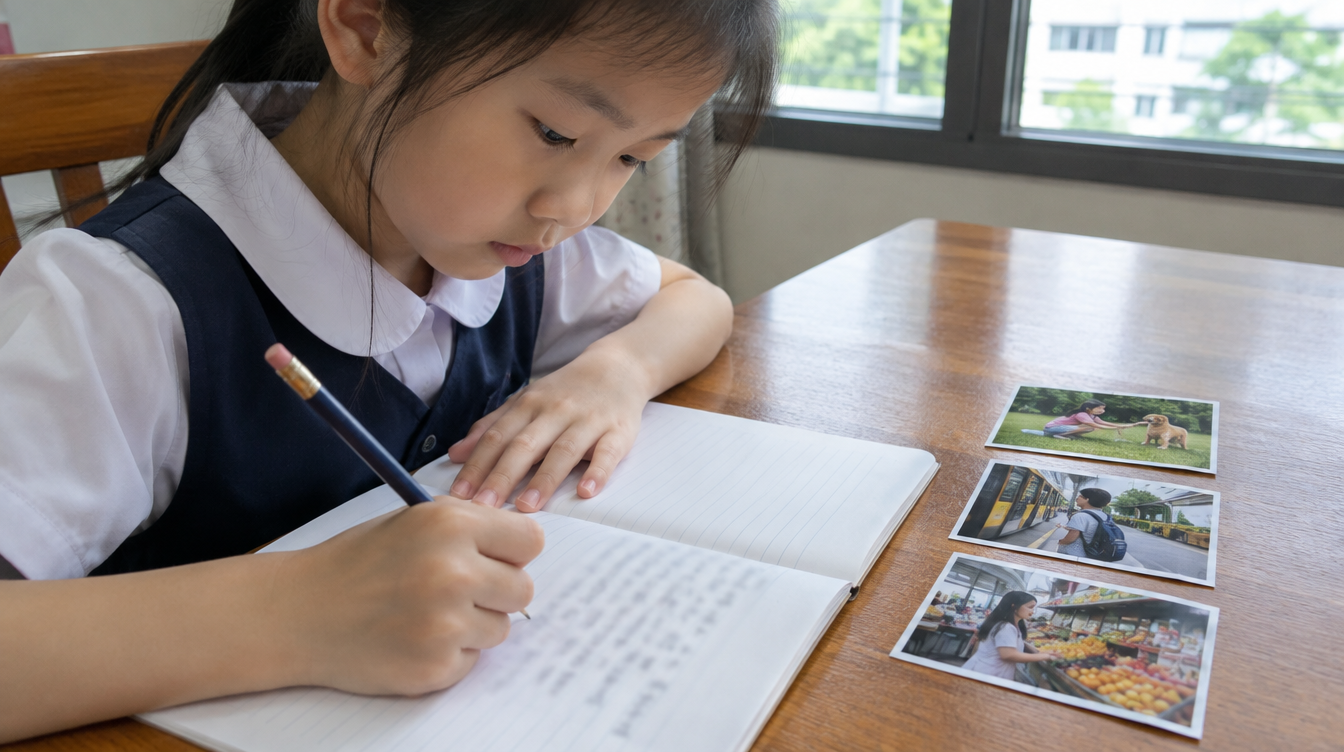
PSLE English Paper 1 is one sitting of 1 hour 10 minutes and 50 marks, a quarter of the English score. Inside it are two tasks: a short functional piece, and a composition of at least 150 words based on at least one of three pictures. The composition is where memorised plots go to fail. The situational piece is where missed content points go to fail.
- Paper
- Paper 1 Writing, 1 h 10 min, 50 marks, 25% of English
- Situational writing
- A short email, letter or report for a purpose, audience and context
- Composition
- At least 150 words, continuous prose, at least one of three pictures
- 2026 mark split used in schools
- 14 for situational writing, 36 for continuous writing
- What earns the mark
- A relevant, developed response to this topic, in the pupil’s own voice
- What to practise
- A 10-minute plan from the pictures, then the writing, then a check
The two tasks
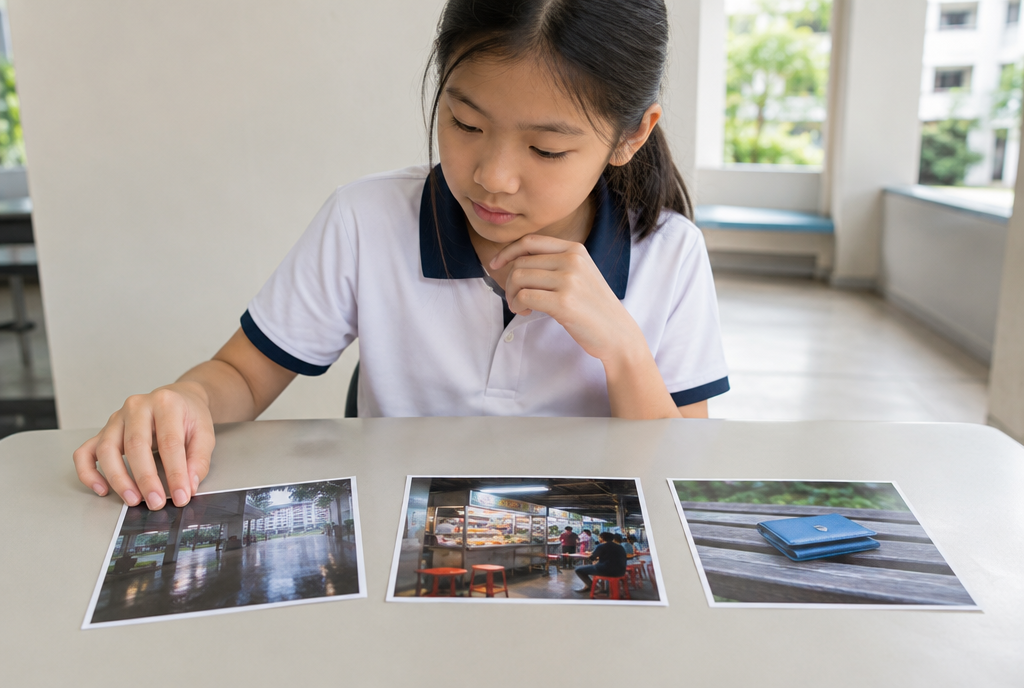
Both tasks sit in the same 70 minutes. The pupil may move time between them. A child who writes the composition first and leaves eight minutes for the email will drop content points that are sitting in the question. A child who spends 40 minutes on the email will rush the piece that carries more of the marks. [1]
| Part | Task | Marks in 2026 briefings | A sensible time |
|---|---|---|---|
| Situational writing | Short functional piece for a purpose, audience and context | 14 | About 20 minutes, including a check of the points |
| Continuous writing | At least 150 words, based on at least one of three pictures | 36 | About 45 minutes, including a 8–10 minute plan |
| Check | Names, tense, and whether the piece answers the topic | Inside the 50 | The last 5 minutes |
Share of the English examination, by paper
Oral, the other paper parents under-practise, is on the PSLE English oral page. Chinese composition is a different paper, on the PSLE 华文作文 page.
How to use the three pictures
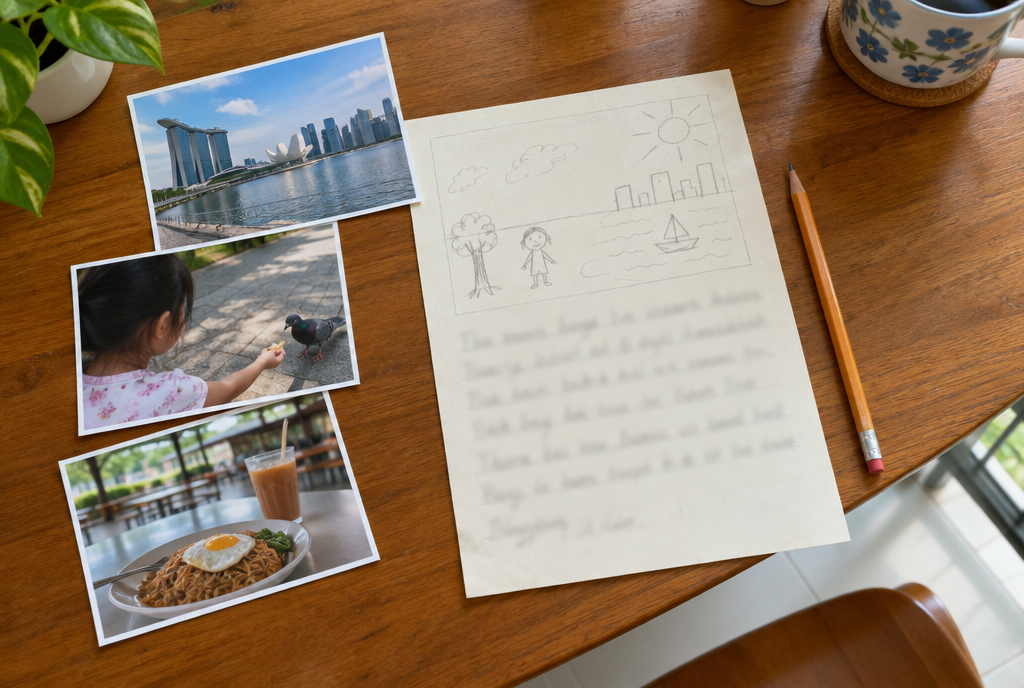
Pick one picture and stay with the topic
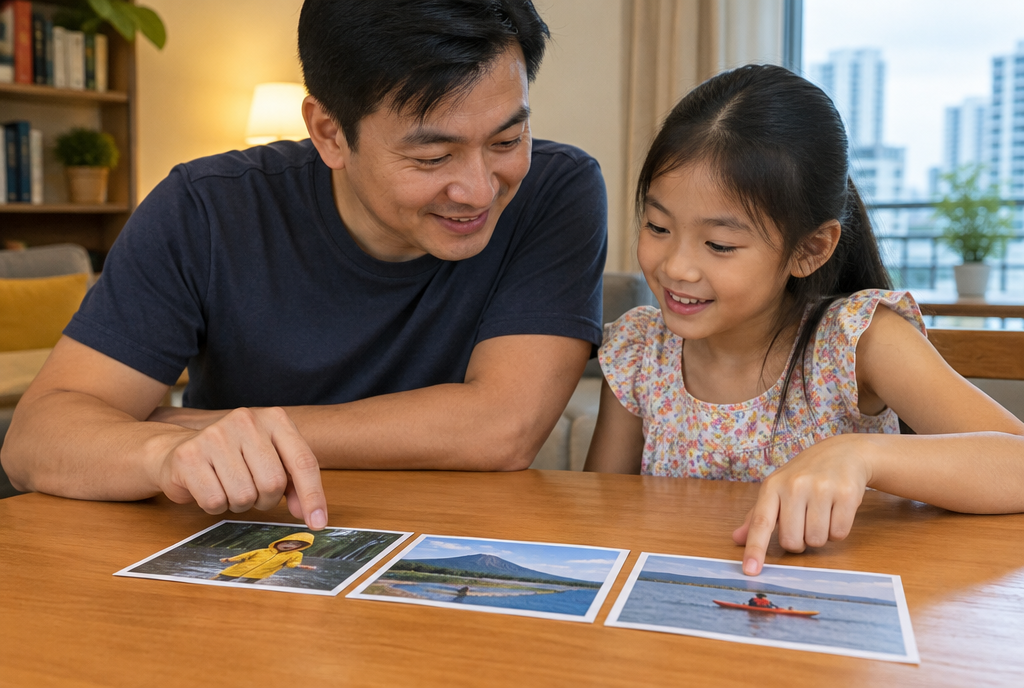
The three pictures are angles, not a command to mention all three. The piece must be based on at least one. A pupil who weaves in every picture usually produces three openings and no story. The plan is four lines, written before the first paragraph:
- Who is in the picture I am using, and what has just happened?
- What does the topic sentence ask me to show, in one clause?
- What changes by the end, for that person?
- Which picture detail will appear in the writing, so the piece is visibly based on it?
SEAB’s public position is that relevant, well-developed responses are credited, and that there is room for the pupil’s own voice. A moral bolted on in the last line does not develop a thin story. One scene, with a reason the character acts, is enough for 150 words.
Phrases that do a job
A phrase is useful when it does one job: place the reader, show a feeling, or move time. A phrase copied in bulk from a model book, with no picture attached, reads as stored. These are jobs, with one original example each. Swap the nouns for the story in front of the child.
| Job | A phrase that does it | Where it goes |
|---|---|---|
| Open on the picture | The queue had not moved, and Mei Ling’s ice cream was already dripping onto her shoe. | First paragraph, with a detail from one picture |
| Show nerves | He read the message twice before he trusted what it said. | When a character hesitates |
| Move time | By the time the bus reached the interchange, the argument was over. | Between two scenes, instead of “suddenly” |
| Give a reason | She agreed because her brother had covered for her the week before. | So the action is caused, not random |
| Close | She kept the ticket in her pencil case, where she would see it on Monday. | Last paragraph, a concrete object, no slogan |
Words that usually weaken a PSLE piece: “suddenly”, “little did I know”, “it was a lesson I would never forget”, and a string of adjectives where one action would do. If the child cannot say what the phrase shows, cut it.
Situational writing, in brief
The piece is short, and the points are in the question. Purpose, audience and context decide the tone: a note to a teacher is not a message to a cousin. Miss one required point and the language marks cannot rescue it. One of the points asks the pupil to supply a fitting idea of their own. That idea has to follow from the situation, not from a favourite hobby pasted in. The full method, including how an email is laid out, is on the situational writing page. [2]
A weekly practice
- One Paper 1 a fortnight, timed at 70 minutes, with the situational piece done first.
- On the other week, a composition only: 10 minutes of plan, 30 minutes of writing, then the child reads it aloud and marks every sentence that could belong to a different topic.
- Keep a single page of phrases that survived that test. Throw out the ones that sound like a model book.
- If the plans are fine and the writing falls apart, the gap is sentences. If the writing is fluent and off-topic, the gap is reading the question. Those are different tutors.
A weekly tutor for Paper 1 is most useful from P5 Term 3, when the pictures start to look like the exam. Rates for a P5 or P6 English tutor are on the rate table.
Questions parents ask
What is the format of PSLE English composition?
Composition is the continuous-writing half of Paper 1. The pupil writes at least 150 words in continuous prose on the topic, using at least one of three pictures. The pictures offer different angles. The pupil may develop their own reading of the topic as long as the piece is based on at least one picture. Paper 1 also contains situational writing, in the same 1 hour 10 minutes.
How many marks is PSLE English Paper 1?
Paper 1 is 50 marks and 25% of PSLE English, in one sitting of 1 hour 10 minutes. School briefings in 2026 split that into 14 marks for situational writing and 36 marks for continuous writing. An older public syllabus lists 15 and 40. If the school brief and an old PDF disagree, follow the brief issued for your child’s year. The task rules, including the 150-word minimum, are the stable part.
How long should a PSLE composition be?
At least 150 words. A piece that stops at 120 words has not met the task, however neat the sentences are. Most pupils who finish comfortably write past 150 and still have time to check tense and names. Length past the minimum does not add marks by itself. A short piece that answers the topic beats a long piece that retells a memorised story.
What is situational writing in PSLE English?
A short functional piece, such as an email, a letter or a report, written for a stated purpose, audience and context. The pupil has to use the information in the question and, in the current task, supply one point of their own that fits. The deeper walk-through is on the situational writing page.
Should my child memorise model compositions?
No. SEAB has said pupils are credited for relevant, well-developed responses, with room for their own voice. A memorised story that ignores the topic and the pictures does not meet that. Practise planning from the pictures in ten minutes, then writing. A bank of phrases for feelings, time and endings is useful. A bank of whole plots is how a child writes the wrong story neatly.
Sources
- Singapore Examinations and Assessment Board, PSLE. Paper 1 is the writing paper. Continuous writing requires at least 150 words in continuous prose on a given topic, based on at least one of three pictures. Situational writing is a short functional piece for a purpose, audience and context. Confirm the current mark split on the syllabus or the school brief for the year. Accessed 13 October 2026. https://www.seab.gov.sg/psle/
- Tutor Circle, situational writing guide. Purpose, audience and context, and how the 70 minutes can be split. Accessed 13 October 2026. https://tutorcircle.sg/situational-writing