How to Help a Child Who Struggles to Focus During Tuition
9 November 2026 · Tutor Circle
Start with the hour in front of you: how long the block is, whether there is a break, what else is in the room, and what you will tell the tutor. Those are changes a family can make this week. They are not a verdict on the child. If attention is hard at school, at the homework table and at play, that is a conversation for the teacher and a doctor. It is outside this page.
- This page
- The lesson: length, break, room, and the note
- Not this page
- Naming a condition
- A first shape
- 15 minutes, a stretch, 20 minutes, then tell a parent
- On the table
- One worksheet. The phone is somewhere else
- The note
- The moment the work stopped, not a label
Length and a break
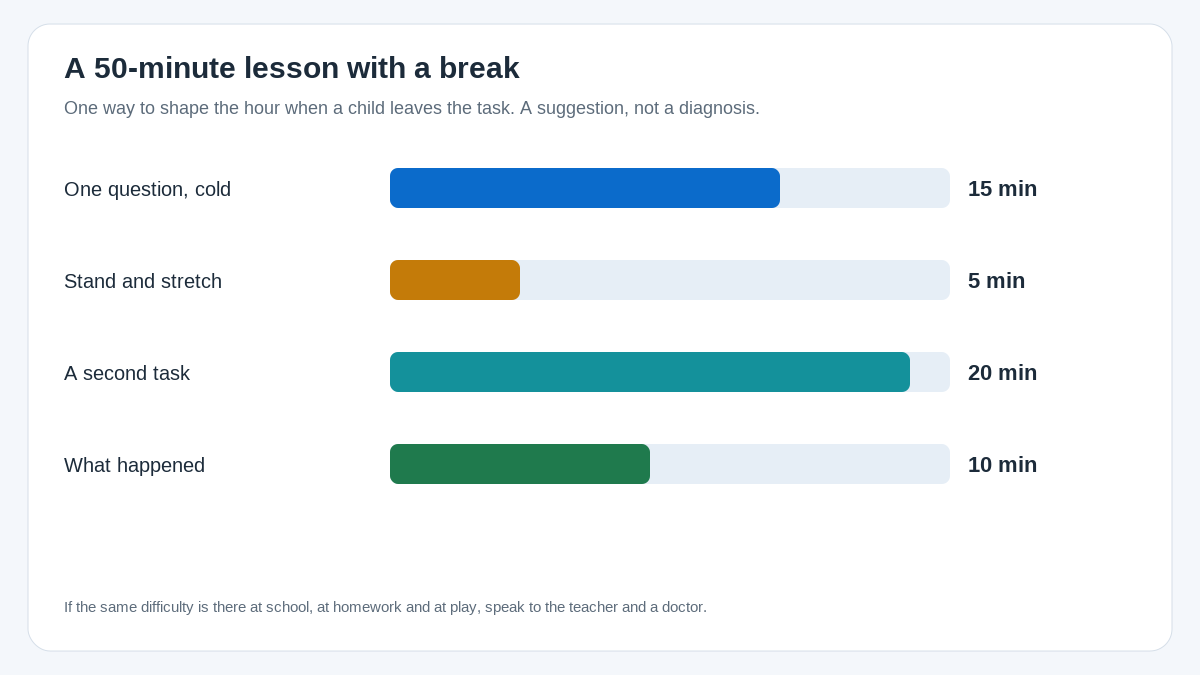
Ask the tutor to try this shape for two weeks. The first 15 minutes are one question the child has not been shown. The stretch is standing up, not a second screen. The next 20 minutes are a similar question. The last 10 minutes are for you: what stopped, and what next week starts with.
If the 15 minutes are not finished, do not add time to prove a point. Shorten the next block, or move the lesson earlier, before dinner and before the longest CCA. An online lesson has the same problem sooner. The first-month lengths by age are on the online tuition page.
A child who is tired, hungry or already two hours into homework will leave a good lesson. Fix the slot before you change the tutor.
The table
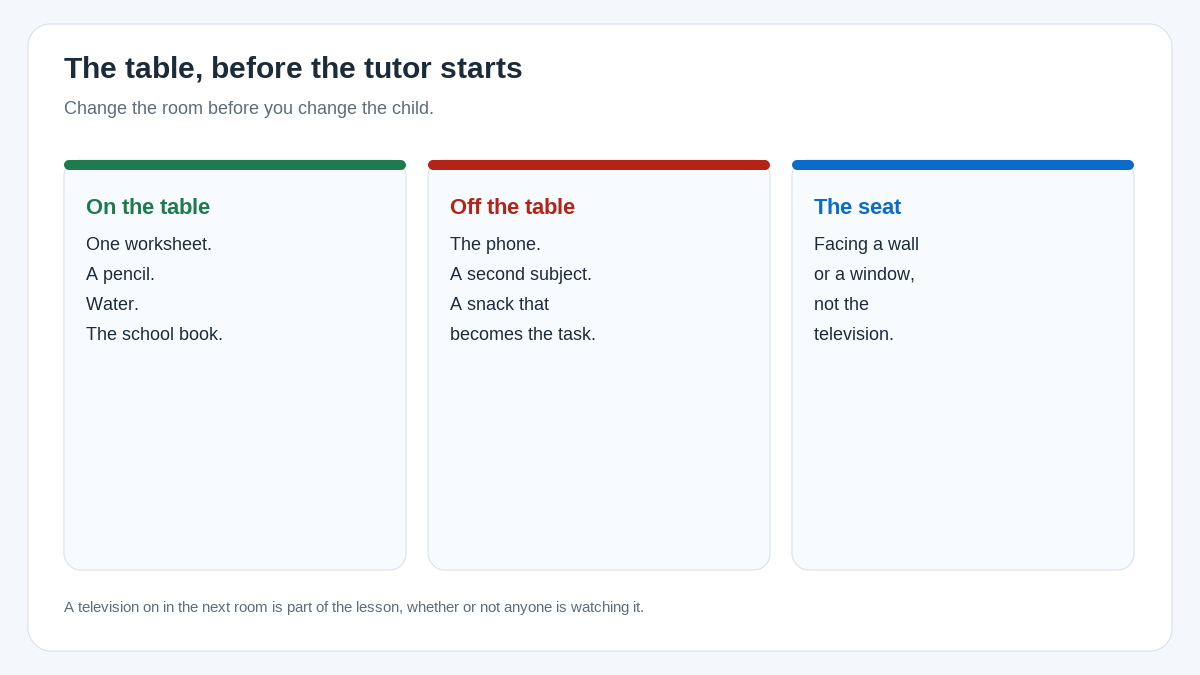
- One subject on the table. The other book can wait in the bag.
- The chair faces a wall or a window, not a screen that is on.
- Water is there. A snack that has to be opened, assembled or shared becomes the task.
- Brothers and sisters are in another room for that block, if the flat allows it. If it does not, say so to the tutor before the lesson, not after.
What to tell the tutor
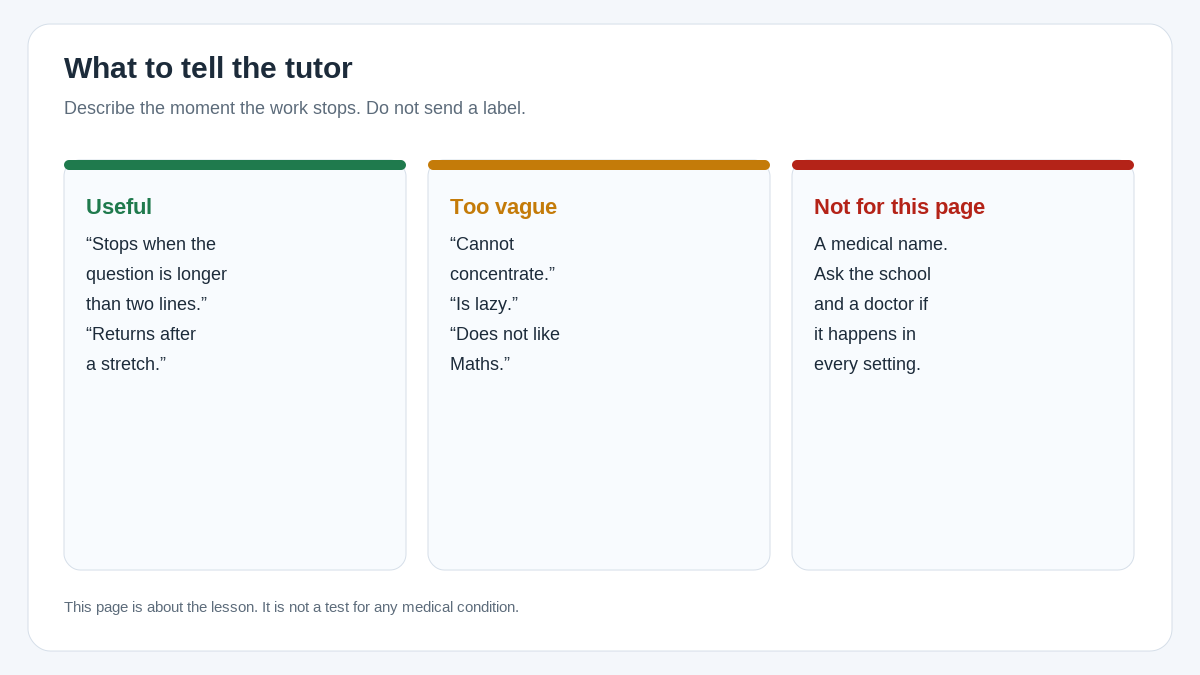
Useful: “Stops when the question is longer than two lines. Returns after a stretch. Does not stop during a short sum.” The tutor can then start with a long question and use the break on purpose.
“Cannot concentrate”, “lazy”, and “does not like Maths” do not tell the tutor when it happens. A medical name does not belong in a tutor brief. If you are worried that the difficulty is in every setting, book the school conversation and the doctor. Keep the tutor message to the lesson.
If the week is the problem
Three subjects in a week that is already full will look like a focus problem. It is often a timetable problem. Hold one subject until that lesson is actually finished, then add another. [1] The check at the fourth lesson is on the progress page. What to put on the table for lesson one is on the parent FAQ.
Questions parents ask
Does a child who fidgets in tuition have a condition?
This page cannot tell you that. It only changes the lesson: a shorter block, a break, a quieter table, and a note to the tutor that describes the moment the work stops. If the same difficulty shows up at school, during homework and during play, speak to the teacher and a doctor.
How long should the lesson be?
When the child leaves the task, try 50 minutes with a break inside it: 15 minutes on one question, 5 minutes up and stretching, 20 minutes on a second task, 10 minutes telling you what happened. Lengthen it only after those blocks are actually finished. A full silent hour is not the first change to make.
Should the tutor be stricter?
A stricter voice does not repair a table facing the television. Ask the tutor to use the break, to keep one worksheet out, and to tell you the moment the work stopped. “Be stricter” is not an instruction they can follow.
What do I write to the tutor?
Write what you saw. “Stops when the question is longer than two lines. Comes back after a stretch.” Do not write a medical word, and do not write “lazy”. The tutor needs the moment, so the next lesson can start there.
Sources
- Tutor Circle, how often a primary child should have tuition. One subject until that subject has a week that is actually happening. Accessed 9 November 2026. https://tutorcircle.sg/how-often-primary-tuition-singapore